Agri-TechAgricultureHarvest
Ernest F. Pembroke writes on pollination, agriculture, and rural technology.
L ooking out aross the golden swathes of oilseed rape, the sturdy stands of field beans, the blossom-laden orchards, and those splendidly varied mixed farming systems one finds dotted about the countryside, pollination endures as one of the most profound—yet devilishly elusive—contributors to a decent yield. Nowadays, growers can gauge soil condition, nutrient uptake, rainfall, and crop progression with the precision of a Savile Row tailor, but pollination? That’s often left to the realm of hopeful presumption: hives are duly positioned, bees are in residence, and one assumes the little blighters are diligently attending to the crops as per the plan.
Pollination is Not a Fixed Input
In truth, pollination is anything but a static affair—it’s a lively, competitive business, utterly at the mercy of the weather, timing, and the broader forage landscape, quite as much as the layout of one’s fields. AI-powered pollen mapping, however, offers a rather elegant means of peering into that reality, rather than piecing it together in hindsight like some post-harvest puzzle.
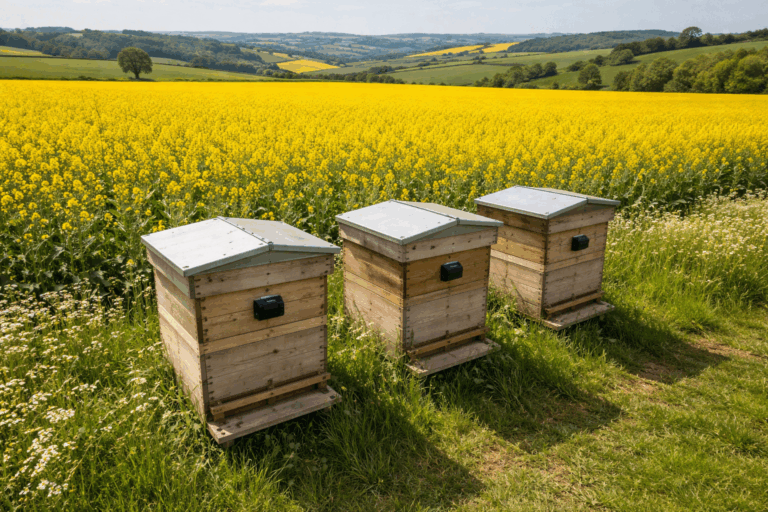
Consider those landscapes where oilseed rape rubs shoulders with ancient hedgerows and wild margins, where field beans share their flowering seasons in a sort of agrarian overlap, and where orchards nestle amidst the arable sprawl—bees, being the discerning foragers they are, make their choices based on reward, pollen quality, and the whims of bloom timing, with scant regard for fence lines or the finer points of one’s pollination contract. Mere bee presence guarantees nothing; especially not when alternative forage beckons with abundance or when flowering phases drift out of sync like an ill-timed waltz.
Seeing Beyond Activity
Enter the Pollen Identification Camera (PIC) from Honey Tree Farms, which rather cleverly identifies the very pollen types that bees cart back to the hive, whilst charting how those foraging habits evolve through the season. Instead of banking on sheer activity, growers can ascertain whether their bees are chiefly devoted to oilseed rape during its prime window, flitting productively between bean crops as conditions alter, or indeed favouring orchard blossoms over rival temptations. Such insights emerge in real time, not as a rueful afterthought when the yield is already set in stone.
Pair this pollen sleuthing with patterns of entrance activity, and pollination transforms from a leap of faith into something one can properly assess and tweak. It equips growers to judge if timings harmonise with flowering stages, if competing forage is siphoning off effort from the star crops, or if hive siting and block sequencing are performing as one might hope. The true boon lies not in mending disasters post facto, but in spotting divergences early enough for a chap to make a difference—perhaps a nudge to the planting calendar or a strategic relocation of hives.
The Mixed-Cropping Problem
This proves especially pertinent on farms juggling multiple pollination-reliant crops at once. Where rape abuts beans, or orchards fringe the arable acres, the slightest vagaries in weather, sowing timetables, or flowering vigour can surreptitiously redirect bee endeavours. Without a window into the hive’s comings and goings, such shifts often slip by unnoticed, yet they account for those vexing year-on-year variances in output, despite one’s best-laid inputs.
AI-powered pollen mapping doesn’t presume to bully bees into unnatural obedience, nor does it supplant sound agronomy or the art of husbandry. Its charm is pure clarity: by verifying which crops are genuinely being foraged, when that attention crests or ebbs, and how it dances to the tune of prevailing conditions, growers acquire a keener grasp of where pollination bolsters yields and where it quietly underwhelms.
The Strategic Payoff
In the fullness of time, such visibility informs wiser choices in crop disposition, hive deployment, and seasonal orchestration. The uplift in yields stems not from brute force, but from banishing those pesky blind spots and taming uncertainty across rape, beans, orchards, and sundry other systems that depend on our winged allies. Studies on AI-driven pollination tools have demonstrated yield boosts of 20-30% in orchards and arable crops by optimizing bee activity and forage alignment. Mind you, those figures hail from systems that lean on vibration monitoring and activity proxies rather than pinpointing pollen types directly on the bees; with the PIC’s more precise revelations into actual foraging, one could expect an even greater uplift in yields, perhaps tipping the scales beyond that 20-30% mark.
Pollination has long lingered in that twilight zone between what a grower jolly well expects to be occurring and what he can actually prove. AI-driven pollen mapping bridges that divide by rendering pollination a quantifiable input—one to be weighed alongside soil, weather, and nutrition. In today’s farming milieu, where margins are as slender as a credit line and variability seems ever on the rise, comprehending how pollinators truly engage with one’s crops is no mere sideshow. It’s weaving itself into the fabric of whole-farm strategy, observed discreetly at the hive’s threshold, where the real toil has always unfolded, measured or otherwise.